Static vs Dynamic: How Guided Dental Implant Surgery Actually Works
Roth Miklós
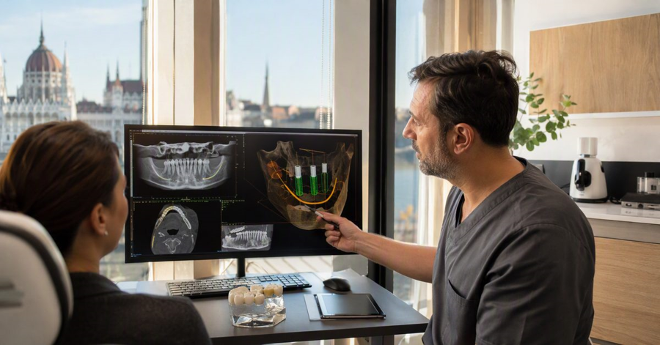
If a dentist has recommended an implant and mentioned "guided surgery," you are probably wondering whether it is a genuine clinical advance or a marketing label. The concise answer: guided implant surgery is an umbrella term for two real, distinct methods — static template guidance and dynamic navigation — that both replace freehand guesswork with a three-dimensional plan made before anyone picks up a drill. The difference between them lies in how that plan is transferred into your mouth, and each has situations where it fits better.
One plan, two ways to follow it
Both approaches start identically. A CBCT scan — cone-beam computed tomography — produces a three-dimensional dataset of your jaws, mapping bone volume, nerve pathways and sinus anatomy, and an intraoral scan adds the teeth and soft tissue. In planning software, the clinician positions a virtual implant in the available bone and aligns it with the future crown. The reviewed overview of how guided dental implant surgery works explains that this "prosthetically driven" logic means the position of the final tooth, not just the thickest bone, dictates where the implant goes.
From that shared plan, the two methods diverge. Static guidance prints it; dynamic navigation tracks it.
Static guidance: the 3D-printed template
In static guided surgery, the digital plan is turned into a physical surgical template — a 3D-printed stent with metal sleeves that fits over your teeth or gums. During the operation, the drill passes through those sleeves, which physically constrain its angle and depth to the planned values.
The strengths are mechanical and predictable: once the template seats correctly, the plan is literally built into the hardware. According to the Hungarian-language summary of the guided implantation workflow, static templates are well suited to straightforward cases, and a separate patient-oriented guide on what to know before booking notes they tend to fit simple, single-tooth situations. The limitations are equally concrete: the template must be designed and printed in advance, it cannot be adjusted mid-surgery if the plan proves wrong, and it adds a fabrication step to your timeline and quote.
Dynamic navigation: a live position on screen
Dynamic navigation removes the template entirely. Instead, a camera tracks small markers attached to the patient's jaw and to the drill handpiece, rendering the drill's live position against the planned implant on a monitor — a principle the reviewed article on dynamic navigation implantation compares to a car's navigation system showing your position on a map rather than prescribing the road.
The practical consequence is real-time correction: if the drill drifts from the planned axis, the deviation is visible immediately and can be adjusted in the moment. The Hungarian version of the same clinical walkthrough adds an honest caveat — the surgeon still controls the handpiece, so training and experience remain decisive. Dynamic systems also keep the plan editable: if anatomy on the day differs from the scan, the plan can be revised rather than discarded. Clinics offering the method, such as Hungarodental — a private group with three locations on Budapest's Buda side, including its XII district centre, which uses the IRIS navigation system — describe it in their own materials as "minimally invasive," because suitable cases can sometimes be treated through a small opening in the gum. Whether that is possible depends on your bone, not on the device alone.
Which approach suits which patient?
Neither method is universally superior, and the sources reviewed converge on the same matching logic:
- Simple, single-tooth cases with generous bone: a static template is often sufficient and can be cost-efficient.
- Tight anatomy, several implants that must align, or borderline bone: dynamic navigation's live feedback becomes genuinely valuable.
- Cases likely to change mid-plan: navigation allows adjustment; a printed template does not.
- Operator factor: both methods still depend on who plans and who drills. The International Team for Implantology, cited in the reviewed material, stresses that careful 3D planning and case selection — not the gadget — sit at the centre of predictable treatment.
A second Hungarian patient guide on guided implant placement makes one more useful point: two clinics recommending the same implant brand can still be proposing different treatments, because the planning decisions drive surgery time and healing, not the hardware label.
A practical way to decide
Treat "static versus dynamic" as a question to bring to a consultation, not a choice to make alone online. Ask whether your case will be planned on a CBCT scan and whether you can see the plan; ask which method the clinic proposes for you and why; and ask for an itemized quote that shows the scan, the planning session and any template separately, since clinics bill these differently. A clinic confident in its process will answer concretely, name its system, and discuss alternatives — including doing nothing for now. Whichever route you lean toward, the final suitability call belongs to a qualified dentist or oral surgeon who has examined your scans, and this article is general information rather than medical advice.
This is a Headline
This is a paragraph. To edit this paragraph, highlight the text and replace it with your own fresh content. Moving this text widget is no problem. Simply drag and drop the widget to your area of choice. Use this space to tell site visitors about your business and story.
© Copyright szonyegwebaruhaz